


In today’s rapidly evolving business landscape, relying solely on traditional training methods is no longer a viable option for organizations striving for leadership and excellence. The growing demand for developing technical and behavioral skills in safe, controlled environments calls for smarter, more effective solutions and that’s where virtual training and simulation come into play.
In high-stakes sectors such as defense, healthcare, energy, and aviation, there is zero tolerance for error making virtual simulation a strategic necessity, not a luxury. At the same time, businesses are under pressure to cut costs and boost productivity without compromising training quality. Virtual simulation offers a highly realistic, interactive experience that enables employees to learn through doing not just watching or listening.
Thanks to the advanced technologies implemented by Marafei, organizations can now benefit from fully customized simulation scenarios that mirror real working conditions, accelerating team readiness and delivering a genuine competitive advantage.
Military and Security Agencies
Require precision training in realistic scenarios such as crisis management, field operations, and command control without real-world risks.
Healthcare Institutions and Hospitals
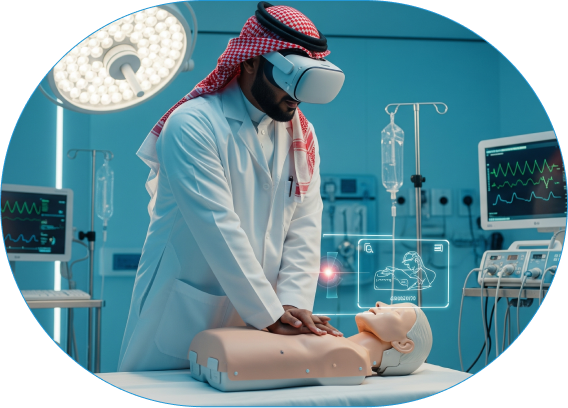
Leverage simulation to train medical staff in surgical procedures and emergency response enhancing competence while ensuring patient safety.
Airlines and Airport Operations
Rely on advanced simulation environments to prepare pilots and navigation teams for complex and emergency flight situations.
Oil, Gas, and Energy Companies
Utilize simulation to train personnel on operating facilities and equipment in high-risk environments improving safety and efficiency.
Government Ministries and Public Agencies
Implement simulation tools to prepare emergency response teams, civil defense units, and technical staff for critical interventions.
Private Sector Companies
Use simulation-based training to upskill teams especially in technical, engineering, and operational roles through customized workplace environments.
Provides highly realistic environments that closely mimic real-world scenarios enhancing comprehension and making training more impactful and effective.
Enables unlimited practice and the ability to tailor scenarios to match each trainee’s role, learning path, or organizational requirements.
Delivers detailed reports on trainee performance, helping organizations refine training programs and make informed, data-backed decisions.
Employees gain hands-on experience through direct interaction, significantly reducing the time needed to master new skills.
Cuts expenses related to travel, accommodation, physical equipment, and training venues making it a smart, cost-effective solution.
Training can be delivered remotely via VR headsets or digital platforms eliminating the need for physical presence and enabling flexible access from anywhere.
Simulated environments allow soldiers and officers to engage in complex mission scenarios ranging from special operations to rescue missions and crisis control without needing physical deployment or exposing lives to risk.
Doctors and nurses benefit from advanced simulation environments that train them in precision surgeries, emergency response, and medical equipment handling—reducing medical errors and enhancing clinical proficiency.
Virtual cockpits replicate real aircraft conditions, covering scenarios such as system failures, adverse weather, and emergency landings boosting crew preparedness and safety.
Operators in oil, gas, and energy sectors are trained to manage complex facilities, response to leaks, and execute emergency shutdowns minimizing operational risks.
Simulation is used to prepare civil defense teams for fires, rescues, chemical spills, and mass evacuations backed by detailed individual performance assessments.
Simulated workplace situations like team management, time-sensitive decision-making, and negotiation allow leaders to sharpen practical skills beyond classroom theory.
Government and private sector staff are trained on advanced systems such as smart city management, traffic control, and digital infrastructure within risk-free, immersive environments.
Simulation is a powerful tool for training students at technical colleges and vocational institutes to operate machinery, diagnose faults, and understand industrial processes without needing costly real-world equipment.
AR/VR scenarios simulate customer interactions, objections, and emergencies building staff confidence, adaptability, and communication under pressure.
Used in public safety campaigns to simulate events such as earthquakes, home accidents, or road safety scenarios especially in schools and community exhibitions for maximum awareness through interactive experience.
At Marafei, we understand that every organization has unique needs, specific operational scenarios, and distinct training objectives depending on the nature of its work and industry. That’s why we offer fully customized virtual training and simulation experiences designed from the ground up to reflect your real-world environment.
We begin with a thorough assessment of your organization’s structure, training goals, and target teams, then develop a digital simulation environment that mirrors your actual work setting. Every element scenario design, language, interaction level, and digital tools are tailored to align with your sector’s standards and the cultural context of Saudi organizations.
We also invite our clients to co-develop training content, ensuring it reflects their day-to-day challenges making the learning process more relevant, impactful, and sustainable. This high degree of customization ensures maximum return on investment and embeds training outcomes deeply into the operational workflow.
In addition to custom scenarios, we offer ready-to-deploy simulation modules for essential training needs, such as first aid procedures, fire extinguisher usage, and other general safety topics.
For a government security agency, we designed a virtual simulation system to train emergency response teams on natural disaster scenarios such as earthquakes, fires, and explosions. The virtual environment was built using realistic maps of critical locations, enabling teams to interact with simulation tools that replicated movement, sound, and real-time consequences of field actions.
In the healthcare sector, we developed an interactive simulation to train nursing teams on patient safety procedures according to international standards. Trainee performance is tracked and evaluated within a risk-free environment enhancing response skills and clinical readiness.
We also partnered with a cybersecurity organization to deliver a professional simulation program that trains employees on how to respond to technical security threats in a virtual setting. This immersive experience equips staff with practical skills to protect the organization’s digital infrastructure effectively.
A case study from Boeing revealed that the company’s adoption of virtual simulation technologies for pilot and engineer training led to a 30% reduction in operational incidents over five years, along with a training efficiency improvement exceeding 60%.
In the healthcare sector, Mayo Clinic implemented an interactive simulation system to train emergency teams, resulting in a 40% increase in medical response speed and a reduction in patient recovery time within emergency departments.
In the energy industry, Shell deployed simulation systems to train field workers on handling high-pressure situations and leakage incidents, significantly reducing operational costs caused by human error.
These examples demonstrate how leading global organizations are achieving real, measurable outcomes through professionally designed virtual training and simulation solutions.
The cost of developing virtual training environments is relatively low compared to traditional training, especially when measured over the medium and long term. In fact, conventional training often incurs ongoing expenses such as travel, accommodation, equipment use, and workflow disruption while virtual simulation offers a far more sustainable and cost-effective alternative.
This solution enables unlimited employee training without recurring costs, making the overall price point significantly more sustainable than traditional methods. Moreover, reducing operational errors caused by insufficient training and improving task performance speed directly contributes to increased returns and minimized losses.
At Marafei, we ensure flexible pricing models tailored to each client’s needs and project scale. Our goal is to deliver maximum value for every riyal invested, backed by measurable, achievable results.
We begin with a deep understanding of the client’s environment to identify training gaps and define the specific objectives to be achieved through virtual solutions.
Our team develops simulation scenarios tailored to the nature of the client’s operations, taking into account cultural context and the real-world operational environment.
We build the simulation using the latest VR and AR technologies, ensuring the highest standards of precision, realism, and interactivity.
The solution is tested within the actual work environment to ensure its effectiveness, followed by necessary adjustments based on client feedback.
The program is officially launched, and staff are trained using the developed systems, with full technical support provided during implementation.
We monitor training outcomes and provide analytical reports and performance data to enhance training effectiveness and ensure target achievement.
The success of virtual training and simulation is not measured solely by the quality of the technology used, but by its ability to bring about real transformation in learning and performance within organizations. At Marafei, we focus on the tangible impact the service has in the workplace enhancing trainee readiness, boosting competence, and improving their ability to handle complex situations with confidence and professionalism.
What sets our approach apart is that we don’t offer isolated virtual experiences; we integrate them into a comprehensive development strategy that enables organizations to achieve their operational and educational goals in smarter, more efficient ways.
The outcomes of our service are reflected in improved overall performance, reduced errors, and accelerated training cycles—all within a safe, repeatable, and scalable environment, without exposing any sensitive or client-specific information.
🔧Continuous 24/7 Technical Support
We provide dedicated support teams to accompany the client during implementation and operation, ensuring a smooth, interruption-free experience.
🔄 Guaranteed Compatibility with Work Environments
We deliver solutions that integrate seamlessly with the client’s existing systems and infrastructure—without requiring major modifications.
🛠 Routine Maintenance and Technical Updates
We offer regular maintenance packages with ongoing updates to enhance system stability and sustainability.
📘 User Documentation and Interactive Help
We provide simple user manuals, instructional videos, and interactive support points to facilitate system usage for end users.
🚀 Scalability and Future Flexibility
Clients have the option to expand and evolve their solution over time, in line with business growth and emerging needs.
At Marafei, we place great emphasis on applying international standards across all our virtual training and simulation projects—not just to ensure technical quality, but to achieve long-term reliability that aligns with public and private sector requirements.
We adopt development methodologies in line with ISO standards for e-learning, and follow global best practices in simulation and interactive experience design—such as SCORM and xAPI to ensure integration and effectiveness.
We also adhere to strict cybersecurity and data privacy protocols, in compliance with national policies and international guidelines offering our clients a safe and stable training environment.
Believing that the Saudi market deserves world-class solutions, we align each project with the latest global trends in technology and education, while preserving the local identity of every organization we serve.
Innovative Saudi Solutions with Global Quality
We develop simulation content and technologies that reflect Saudi culture and precisely address local market needs.
Fast Execution with Full Customization
We deliver quickly without compromising quality, and offer high flexibility in scenario customization for each client.
A National Team with Global Expertise
Our team includes top-tier Saudi engineers, designers, and developers experienced in cutting-edge VR and simulation technologies.
High Technical Integration
We ensure seamless integration with the client’s internal systems, enabling a smooth, error-free experience.
Trust and Strategic Partnerships
We build relationships based on transparency and trust, and aim to be a true partner in enhancing our clients’ capabilities.
✅ Simulation provides a realistic, interactive, and risk-free environment, while traditional training relies on limited instruction or physical practice. Simulation accelerates learning and improves practical performance.
✅ Yes, some simulation models can be delivered via computers and tablets. However, full benefit is achieved through the use of VR/AR technologies—depending on the training context.
✅ Timelines vary depending on project size and scenario complexity, but typically range between 3 to 8 weeks with acceleration options available if content is ready.
+966-500526869
08:00 AM - 06:00 PM